
The Day I Stood at the Edge of the Sea and Finally Forgot to Worry By Riza
- thevoiceofdomesticworkers

- 7 hours ago
- 6 min read
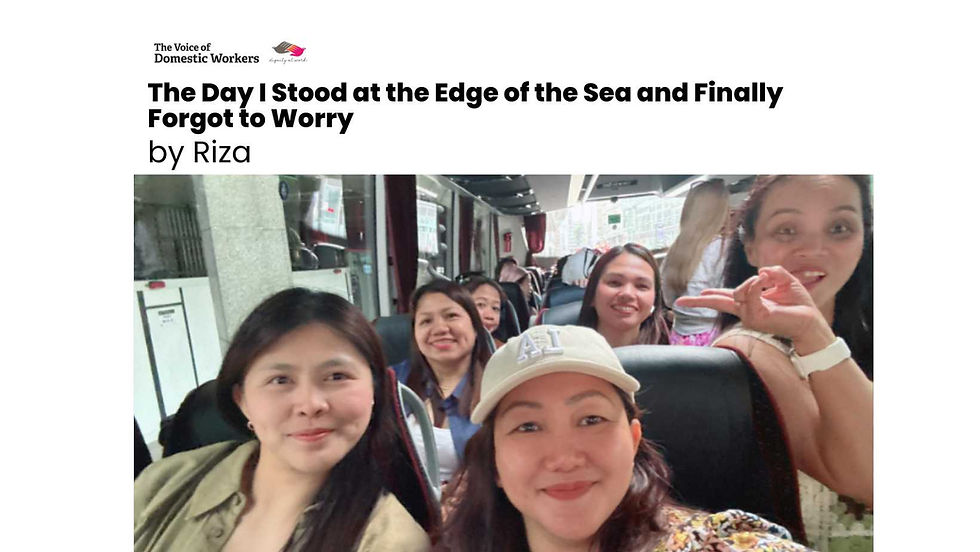
I had been looking forward to this day for so long. Not in the way you look forward to something you are not sure will actually happen, but in the way you hold a small and precious thing carefully in your mind, returning to it again and again, letting the thought of it carry you through the harder days. And when the day finally arrived, it was better than anything I had imagined. From the very first moment to the very last, it was more than I had dared to hope for.
The journey there was already its own kind of joy. We piled into the coach together, the noise and warmth of everyone finding their seats, settling in, beginning to relax into the freedom of a day that belonged entirely to us. Songs came on and we sang along, not quietly or self-consciously but fully, the way you only sing when you are with people who make you feel completely safe. Outside the windows, the houses and streets gradually faded and gave way to green fields that stretched wide and generous in every direction. And then, at some point during the journey, a sliver of blue appeared on the horizon. The sea. Everyone saw it at the same moment and the reaction was immediate, a ripple of excitement moving through the coach like a current. We passed snacks back and forth, pointed out views, talked and laughed through the whole drive, and I remember thinking that the journey itself already felt like a gift.
When we finally stepped onto the sand, something happened to me that I was not fully prepared for. The air changed. The sound changed. Everything that had been sitting heavily on my shoulders, the weight that accumulates so quietly over weeks and months of long working hours and uncertainty and the particular exhaustion of caring for others while your own needs go unmet, all of it began to lift. Not disappear entirely, but lift enough for me to breathe properly, the kind of breathing you forget you have not been doing until suddenly you are doing it again.
I looked for shells along the water's edge, bending down to pick up the ones that caught my eye, turning them over in my hands, marvelling at the simple perfection of something the sea had shaped over years without any help from anyone. Then I stood exactly where the water meets the sand and let the cool waves run over my feet, back and forth, back and forth, and I laughed at the cold of it and at nothing in particular and at everything all at once. Around me, the people I have come to love were swimming and splashing and living fully in that moment, and I looked at all of them and felt something I want to remember for the rest of my life. I felt lucky. Genuinely, deeply, unexpectedly lucky.
These are the people who make ordinary moments feel like magic. I have thought about that many times since that day, about what it means to have found a community that transforms the texture of your life simply by being in it. The Voice of Domestic Workers gave me that community. It gave me people who understand without explanation, who show up without being asked, who pile onto a coach on a sunny day and sing songs and share snacks and make a beach feel like the most important place in the world. That kind of belonging is not something that can be legislated into existence, but it is something that legislation can protect.
The right to change employer without restriction protects it by ensuring that a domestic worker is never so trapped in a harmful situation that they lose access to the community sustaining them. Freedom at work makes every other freedom more reachable.
For those few hours by the sea, there was no rush and there were no worries. There was only sun on our faces and salt in the air and the knowledge that for this one afternoon, the world was asking nothing of us except to enjoy it. That feeling, of existing without obligation for a little while, is one that domestic workers rarely get to experience fully. Because even on days off, the worry tends to follow.
The uncertainty about visa status, about what happens when a contract ends, about whether the years being given to this country will ever be properly recognised, it all travels with you if you let it. The right to renew the Overseas Domestic Worker Visa is what quiets that particular worry. It is what allows a day at the beach to be simply a day at the beach, without an expiry date casting a shadow over every peaceful moment.
The drive home was the kind of quiet that only comes after a day well spent. Most of us were tired in the best possible way, the tiredness that comes from fresh air and laughter and salt water, and heads were leaning against windows, eyes closing, smiles still resting on faces even in sleep. We were already talking, in the drowsy half-awake way of happy people, about when we could do it all again. That conversation, about a future trip, about a next time, about the assumption that there would be more days like this one, felt significant to me. Because not every domestic worker gets to assume a next time. Not everyone gets to plan ahead with the confidence that they will still be here, still be part of this community, still be allowed to pile onto a coach and chase the horizon together.
The right to settlement is what gives domestic workers the ability to assume a next time with confidence. It is what replaces the constant uncertainty of will I still be here with the steady reassurance of yes, this is my home and I am staying. It converts the fear of an ending into the possibility of a continuation, and that conversion changes everything. It changes how you breathe on a coach journey. It changes how freely you laugh at the water's edge. It changes what it feels like to fall asleep on the way home from a perfect day.
And the right to British citizenship changes something even more fundamental. It says that the person who stood at the edge of the sea that afternoon and felt lucky and grateful and fully alive belongs to this country in every legal and permanent sense. That the love she has developed for this place, its green fields and blue horizons and the community she has found within it, is not temporary or conditional. That she is not a guest here but a citizen, with all the dignity and security and recognition that word carries.
I will hold this whole day close for a very long time. The singing on the coach and the shells in my hands and the cold waves over my feet and the faces of the people around me living so fully in that one golden afternoon. This is what happiness really feels like. Not the complicated kind that comes with conditions and caveats, but the simple, honest, completely human kind that asks for nothing except your presence and gives back everything in return.
Every domestic worker deserves a day like this. Not as a rare exception. Not as something to be grateful for beyond measure. But as a normal and regular part of a life that is full and free and genuinely their own.
That is the life we are fighting for. And days like this one remind me, with absolute certainty, that it is worth every step of the fight.
Join Us in Supporting Migrant Domestic Workers Escaping Abuse
Migrant domestic workers who have fled abusive employment urgently need your help. They’ve left behind exploitation and are taking brave steps toward safety—but they need support for basic needs like shelter, food, clothing, and counseling.
"With your donation, we can provide immediate relief and a pathway to rebuilding lives in dignity and safety."
Every contribution, no matter the size, helps us provide essentials, temporary housing, job training, and emotional support. Together, we can offer a lifeline to those starting over.
Donate today to make an impact and be a part of their journey to freedom, recovery, and empowerment.


Comments